
Choosing the right Eva Deck Flooring requires more than comparing colors, thicknesses, and advertised prices. Global buyers must examine foam density, surface texture, adhesive compatibility, drainage, and resistance to ultraviolet exposure. A soft-looking sheet may feel comfortable, yet it can compress quickly beneath fishing chairs, coolers, or repeated foot traffic. Small details matter.
Marine systems consultant Steve D’Antonio offers a useful principle: “A boat’s systems must work together, not separately.” That thinking fits deck flooring closely. Eva Deck Flooring should match the boat’s substrate, cleaning routine, climate, and installation method. Saltwater, tropical heat, freezing temperatures, and muddy footwear create very different demands. A product that performs well on a sheltered yacht may fail on an exposed workboat. Context changes everything.
This guide examines ten common types of Eva Deck Flooring available to international buyers. The comparison considers closed-cell foam construction, embossed patterns, teak-style finishes, camouflage designs, drainage grooves, self-adhesive backing, and custom-cut formats. Each option has practical strengths. Each also has limits. No material is perfect.
Buyers should request samples before placing large orders. Press the sample with a thumb. Wipe it with a damp cloth. Check whether the adhesive suits aluminum, fiberglass, plywood, or painted surfaces. Measure temperature changes, too. A rushed purchase can create peeling edges, trapped moisture, and expensive rework. The best choice is rarely the cheapest one. It is the flooring that remains comfortable, stable, and maintainable in real operating conditions.
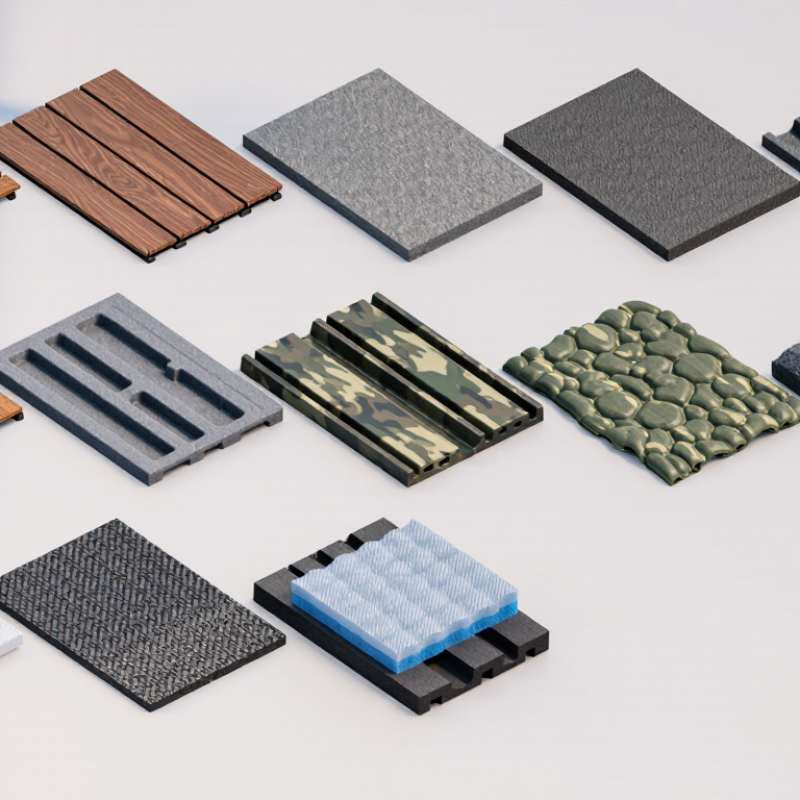
EVA deck flooring uses ethylene-vinyl acetate foam as its cushioning core. The material is lightweight, flexible, and naturally resistant to water absorption. Cross-linked EVA usually offers better dimensional stability than ordinary foam. However, softness can increase under strong heat. That trade-off matters.
Most products use a closed-cell foam sheet, a textured wear surface, and a pressure-sensitive adhesive layer. Grooves or embossed patterns help water move away from standing areas. Foam density, vinyl acetate content, and cell structure control comfort and recovery. ASTM D3575 is commonly referenced for flexible cellular materials. Hardness testing often follows ASTM D2240. These tests support comparison, but they do not reproduce every marine condition.
The Grand View Research EVA foam market report identifies construction, automotive, and footwear as major demand sectors, with continued growth expected through the decade. This broader trend supports wider material availability for deck applications. Still, market growth does not guarantee reliable flooring. Buyers should request density, compression-set, peel-strength, abrasion, and UV-aging results. ASTM D4060 can help assess abrasion resistance. Adhesive performance deserves equal attention. A durable foam can fail when bonding weakens near a hot, wet edge. That point is easy to overlook. Real decks expose weaknesses. Evaluating samples after heat, saltwater, footwear traffic, and repeated cleaning gives a more honest specification.
Top 10 Types of EVA Deck Flooring for Global Buyers
Top 10 EVA Deck Flooring Types by Surface Design and Application
EVA deck flooring varies by surface pattern, grip, drainage, and installation needs. Teak-groove EVA suits yacht cockpits, swim platforms, and fishing boats. Its dark grooves hide dirt, but they still need regular rinsing. Simulated woodgrain flooring creates a warm appearance for balconies, docks, and recreational boats. Brushed-line surfaces feel practical under bare feet and support clean, modern layouts. They may show scratches more clearly.
Diamond-pattern EVA offers firm traction on workboats, trailers, and equipment platforms. Raised-dot flooring works well around coolers, storage areas, and vehicle steps. Pebble-textured EVA provides softer contact for kneeling or standing. It can collect sand in coastal conditions. Ribbed EVA directs shallow water toward edges and supports boat walkways. Woven-texture designs add visual interest to cabin floors and outdoor seating spaces. Perforated or drainage-pattern EVA helps manage water near swim platforms and washdown zones. Smooth matte EVA is suitable for low-traffic interiors, though it provides less grip when wet.
From practical installation experience, surface texture should match actual movement patterns. A heavily grooved deck can feel uncomfortable during long standing periods. A soft pattern may look attractive but wear faster beneath metal tools. Measure expansion gaps, prepare the substrate, and test adhesive compatibility before full installation. Color differences can also appear between production batches. That detail is easy to overlook. EVA flooring is not maintenance-free, and every design involves a compromise between comfort, traction, cleaning, and service life.
| Rank | EVA Deck Flooring Type | Surface Design | Typical Thickness | Wet Traction | Drainage Performance | Common Applications | Main Advantages | Key Considerations |
|---|---|---|---|---|---|---|---|---|
| 1 | Teak-Pattern Grooved EVA Foam | Wood-grain appearance with contrasting grooves or lines | 5–10 mm | High | Very good when grooves are continuous | Boat decks, swim platforms, yacht cockpits, docks and marine steps | Combines a traditional teak appearance with cushioning, low weight and easy maintenance | Groove depth and spacing affect cleaning, drainage and visual appearance |
| 2 | Brushed Linear-Texture EVA Flooring | Fine directional lines with a brushed or sanded visual effect | 5–8 mm | Medium–High | Good with grooves or fitted drainage channels | Yacht decks, boat cockpits, recreational vehicles and outdoor platforms | Clean modern appearance and comfortable underfoot feel | Directional texture may show dirt or wear more visibly than random embossing |
| 3 | Diamond-Pattern EVA Deck Mat | Raised diamond or plate-style embossing | 5–10 mm | High | Good surface water release | Workboats, fishing boats, utility decks, steps and equipment platforms | Strong mechanical grip and a practical industrial appearance | More pronounced embossing may be less comfortable for prolonged barefoot use |
| 4 | Hexagonal or Honeycomb EVA Foam | Repeating hexagonal cells or honeycomb embossing | 5–8 mm | Medium–High | Good, depending on cell depth and panel layout | Kayaks, paddleboards, personal watercraft and compact boat decks | Distinctive appearance, lightweight construction and distributed cushioning | Small recessed cells can retain sand or fine debris if not cleaned regularly |
| 5 | Woven- or Fabric-Texture EVA Flooring | Embossed textile, woven or crosshatch surface pattern | 5–8 mm | Medium–High | Moderate to good | Marine interiors, cockpit seating areas, RV floors and leisure platforms | Soft tactile feel with a less technical appearance | Fine textured areas require suitable brushes for effective cleaning |
| 6 | Pebble- or Stone-Embossed EVA Mat | Random rounded bumps that imitate a pebble or stone surface | 6–10 mm | High | Good when installed with perimeter gaps or drainage paths | Swim platforms, barefoot deck areas, pontoon boats and poolside surfaces | Comfortable cushioning and effective grip in wet environments | Irregular texture can make tight edge trimming and residue removal more demanding |
| 7 | Fine-Textured Solid-Color EVA Decking | Uniform matte surface with a subtle non-slip texture | 5–8 mm | Medium | Moderate; depends mainly on installation gaps | Boat interiors, cabin floors, storage lids, steps and recreational equipment | Simple appearance, flexible color coordination and easy panel matching | Less aggressive texture may be unsuitable for high-slip industrial areas |
| 8 | Two-Tone Checkerboard EVA Flooring | Alternating squares or blocks in two contrasting colors | 5–10 mm | Medium–High | Good when used with open joints or drainage grooves | Boat steps, fishing decks, utility areas, trailers and outdoor work platforms | Improves visual contrast and can help define walking or working zones | Color alignment and seam accuracy are important during installation |
| 9 | Printed or Camouflage-Pattern EVA Decking | Decorative printed graphics, camouflage or nature-inspired patterns | 5–8 mm | Medium–High | Moderate to good, based on the embossed base texture | Fishing boats, hunting equipment, outdoor recreational vehicles and personal watercraft | Provides decorative customization while retaining foam cushioning | Print durability depends on UV exposure, abrasion and the protective surface layer |
| 10 | Contour-Cut Modular EVA Deck Panels | Interlocking, multi-panel or precisely cut shapes with selected textures | 5–10 mm | Medium–High | Good when panel joints and channels are correctly planned | Custom boat layouts, irregular swim platforms, cockpit floors and equipment bays | Efficient coverage of curved or irregular surfaces with replaceable sections | Accurate measurements, clean subfloor preparation and careful seam placement are essential |
Technical note: Thickness, traction and drainage vary according to foam density, embossing depth, adhesive method, panel layout and installation conditions. The ranges shown are typical specifications for EVA marine and outdoor deck applications.
Comparing EVA deck flooring starts with the environment, not the pattern. The ten common options include smooth, brushed, diamond, teak-look, camo, perforated, drainage, high-density, self-adhesive, and recycled-content sheets. Grand View Research’s 2024 EVA foam market report places global demand at roughly US$8 billion in 2023, driven mainly by construction, footwear, and packaging. That figure shows scale, not marine performance. Buyers still need product-level evidence.
For boats, inspect closed-cell structure, water absorption, peel strength, compression set, and resistance to fuel or saltwater. Ask for test methods, not vague phrases such as “marine grade.” ASTM D3575 can support cellular-material testing, while ASTM G154 helps evaluate accelerated UV exposure. Outdoor buyers should also check surface temperature, drainage, and color stability. Dark EVA can become uncomfortable under direct sun. Very soft foam feels pleasant under bare feet, but it may dent beneath coolers, ladders, or fishing seats. High-density foam usually resists indentation better, though it can feel less forgiving.
A 2023 NOAA climate report recorded 27 separate billion-dollar weather disasters in the United States, reinforcing the need to consider stronger sunlight, heat, and severe weather exposure. That is not a flooring warranty. It is a practical warning. Installation quality matters too. Dust, trapped moisture, and poor edge sealing can defeat a good sheet. I would compare samples after wet handling, repeated compression, and several days of sunlight, because laboratory results alone can feel incomplete.
Comparing typical EVA deck flooring thickness helps buyers evaluate cushioning, durability, drainage, installation method, and suitability for marine and outdoor environments.
The chart uses representative midpoint values from common commercial specifications. Actual thickness, surface texture, adhesive backing, UV resistance, and service life vary by supplier and application. Thicker constructions generally provide greater cushioning and wear resistance, while thinner sheets are easier to cut and install.
Global buyers should compare EVA deck flooring by structure, not appearance alone. Common options include interlocking tiles, adhesive sheets, rolls, diamond-pattern panels, teak-look planks, camouflage designs, anti-fatigue mats, marine-grade sheets, gym-style tiles, and custom-cut panels. Each type suits different spaces. Rolls reduce seams, while interlocking tiles simplify replacement. Teak-look surfaces may improve visual warmth, but textured patterns can trap dirt.
Measure the deck in both metres and feet before ordering. Record length, width, curves, hatches, and drainage gaps. Allow a small fitting margin, but do not guess. EVA foam expands under heat and may contract in cold conditions. A clean, dry, oil-free substrate is essential. Test adhesive compatibility on a hidden area first. Install during moderate weather, press seams firmly, and leave enough time for curing. Some buyers rush this step, then blame the material.
Maintenance is usually simple. Sweep sand daily in busy areas and wash with mild soap and fresh water. Avoid harsh solvents, stiff wire brushes, and excessive pressure. Inspect lifting edges, bubbles, and worn textures every few months. Wet EVA can improve grip, but algae, grease, or loose debris can still create hazards. Use non-slip footwear and keep emergency access clear. Colour fading is possible under strong sunlight; this is often underestimated. Check UV resistance, fire requirements, chemical exposure, and local marine standards before purchase.
Selecting EVA deck flooring starts with the supplier, not the color chart. Global buyers should request clear data on foam density, thickness, closed-cell structure, UV resistance, and water absorption. A reliable supplier explains how each EVA type performs on fishing boats, yachts, pontoons, or outdoor platforms. Ask for production samples. Check their edges, surface texture, adhesive backing, and dimensional stability after heat exposure. Small differences matter under wet shoes.
Documentation also deserves careful attention. Look for batch traceability, material specifications, quality inspection records, and export experience. Suppliers should provide realistic lead times and explain how they handle damaged rolls, shade variation, or adhesive failure. Product compliance must match the destination market. Do not accept vague claims such as “marine quality.” Request test methods and recent results. A low price can hide thinner foam or unstable coloring. No supplier looks perfect on paper.
Tips: Compare at least three samples in direct sunlight and water. Press each sample with a wet shoe. Inspect recovery after compression. Confirm minimum order quantities, packaging, replacement terms, and installation guidance before payment. It is also wise to test a small installation area first. Even careful buyers can overlook deck temperature, which may affect adhesive performance. Rechecking this detail can prevent an expensive mistake.