
Choosing the right LCD Touch Screen supplier can determine whether a product launch feels reliable or becomes an expensive engineering lesson. Global buyers must examine more than pixel resolution and catalog prices. They should review touch sensitivity, cover-glass strength, optical bonding, operating temperature, and long-term production capacity.
Real performance appears in details. A factory sample may respond smoothly under dry fingers, yet fail when gloves, moisture, or protective films are introduced. Buyers should request test reports, dimensional drawings, connector specifications, and samples from the intended production line. Quality consistency matters.
Not just specifications.
Bob Raikes, a longtime display-industry analyst and founder of Meko, has repeatedly emphasized that display purchasing is also a supply-chain decision. That view deserves attention. A technically strong panel is still a poor choice if the supplier cannot control component sourcing, maintain stable lead times, or provide clear engineering support.
This guide examines leading LCD Touch Screen suppliers for global buyers. It considers manufacturing experience, customization capability, inspection procedures, certifications, communication quality, and after-sales support. It also looks at less visible risks, including tooling ownership, minimum order quantities, firmware compatibility, and replacement planning.
The comparison cannot promise one perfect supplier. Requirements differ between handheld terminals, medical equipment, vehicles, kiosks, and industrial control panels. Some conclusions may need revision as technologies and supply conditions change. That is the honest limitation.
A practical supplier shortlist should begin with evidence, not impressive websites. Ask for traceable samples, measurable test results, and realistic delivery commitments. Then verify whether those promises survive production pressure.
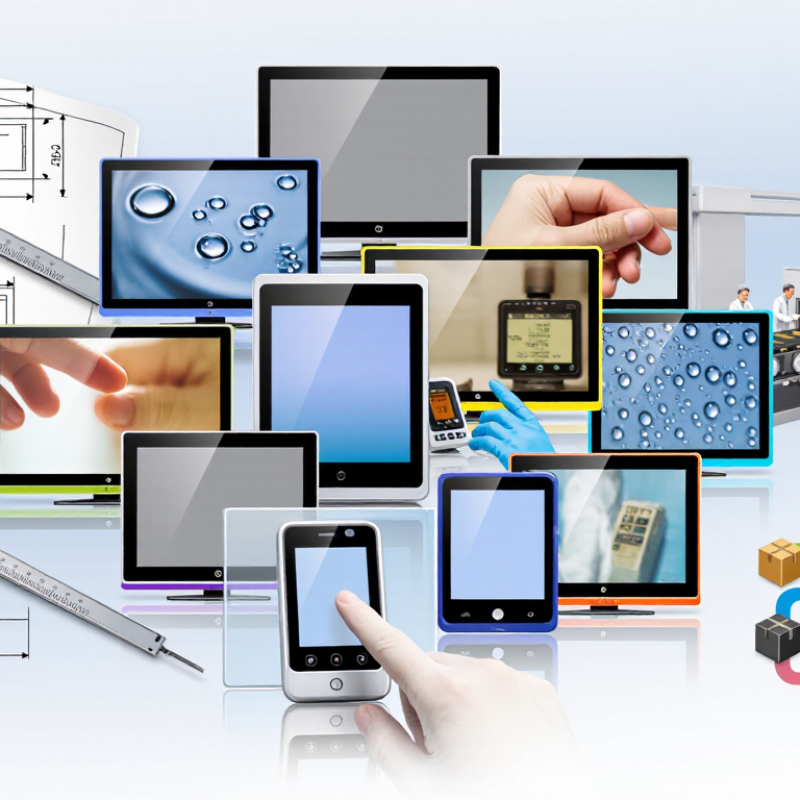
LCD touch screens combine a liquid crystal display with a touch-sensing layer. The LCD creates images through controlled light and colored pixels. The touch layer detects a finger, stylus, or gloved hand. In practical equipment, this may be a 7-inch control panel or a large kiosk display.
Capacitive touchscreens are common in phones, instruments, and smart appliances. They respond quickly and support gestures, but thick gloves can reduce sensitivity. Resistive screens use pressure between flexible layers. They work well with pens and gloves, even in dusty workshops. Projected capacitive technology offers strong clarity and multi-touch control. Infrared systems detect interruptions across a light grid and suit larger displays.
Core performance depends on more than resolution. Engineers should check brightness, viewing angle, response time, surface hardness, and operating temperature. Optical bonding can reduce reflections between the LCD and touch layer. This matters near windows or under bright factory lights. A reliable supplier should provide measured data, sample testing, and clear integration drawings. Ask about connector placement, mounting tolerance, and expected service life.
Small details cause expensive redesigns. A screen may look excellent indoors but fail under direct sunlight. I have seen specifications hide this weakness. Test with the actual enclosure, gloves, cables, and lighting conditions. No single touch technology fits every product.
| No. | Data Dimension | Typical Data or Classification | Technical and Purchasing Relevance |
|---|---|---|---|
| 1 | Definition | An LCD touch screen combines a liquid-crystal display module with a touch-sensing layer and a controller. | The LCD produces the image, while the touch system detects finger, stylus, or gloved-hand input and converts it into digital coordinates. |
| 2 | Common Touch Technology | Projected capacitive, resistive, surface capacitive, infrared, and surface acoustic wave. | Projected capacitive is widely used in modern consumer and industrial interfaces. Resistive technology remains useful where gloves, pens, moisture, or low cost are priorities. |
| 3 | LCD Panel Modes | TFT-LCD using TN, IPS, or VA liquid-crystal modes. | IPS generally provides wide viewing angles and stable color. TN can offer fast response and economical pricing. VA commonly provides higher native contrast than TN. |
| 4 | Typical Screen Sizes | Approximately 2.4–7 inches for compact devices; 8–15.6 inches for control panels; 17 inches and above for larger interfaces. | The correct size depends on viewing distance, available installation space, required button area, resolution, and target application. |
| 5 | Touch Input Capability | Single-touch or multi-touch; common projected-capacitive modules support two or more touch points. | Multi-touch support enables gestures such as pinch-to-zoom and rotation. Buyers should confirm the actual controller and operating-system compatibility rather than relying only on the panel description. |
| 6 | Common Resolutions | Examples include 480 × 272, 800 × 480, 1024 × 600, 1280 × 800, and 1920 × 1080 pixels. | Resolution should be selected according to content detail, viewing distance, graphics performance, power budget, and interface bandwidth. |
| 7 | Brightness Range | Indoor modules often range from about 250 to 500 cd/m²; sunlight-readable designs may reach 800 cd/m² or more. | Higher brightness improves outdoor readability but can increase power consumption and heat. Optical bonding and anti-reflective treatment can also improve visibility. |
| 8 | Viewing Angle | Typical specifications are expressed as horizontal and vertical angles measured from the normal viewing direction. | Wide viewing angles are important for shared displays, vehicle interfaces, medical equipment, and industrial control panels. |
| 9 | Host Interfaces | Display interfaces may include RGB, MCU, LVDS, MIPI DSI, or eDP. Touch controllers commonly use I²C, USB, or SPI. | Interface selection must match the host processor, software drivers, cable length, data rate, connector type, and electromagnetic-compatibility requirements. |
| 10 | Cover-Lens Options | Glass or plastic cover lenses with options such as anti-glare, anti-fingerprint, chemically strengthened glass, and custom printing. | The cover lens affects durability, optical clarity, cleanability, touch sensitivity, appearance, and resistance to scratches or impact. |
| 11 | Bonding Methods | Air-gap bonding, optical bonding, and direct bonding. | Optical bonding reduces internal reflections and improves readability and shock resistance, but it generally increases cost and manufacturing complexity. |
| 12 | Operating Environment | Commercial, industrial, automotive, medical, retail, and outdoor applications. | Global buyers should define temperature range, humidity, vibration, shock, dust or water exposure, chemical contact, UV exposure, and expected service life. |
| 13 | Glove and Water Performance | Performance varies by sensor design, glove material, moisture level, firmware, and tuning. | Suppliers should provide application-specific test results for wet touch, thick gloves, palm rejection, and unintended activation. |
| 14 | Customization Services | Custom dimensions, bezels, connectors, cable routing, cover lenses, firmware settings, and mounting structures. | Customization can improve mechanical and electrical integration. Buyers should confirm tooling charges, engineering samples, minimum order quantity, and change-control procedures. |
| 15 | Quality and Compliance Checks | Dimensional inspection, optical testing, touch accuracy testing, environmental testing, reliability testing, and applicable market compliance. | Request product specifications, inspection records, reliability data, material declarations, and applicable declarations of conformity before volume purchasing. |
| 16 | Supplier Evaluation Criteria | Technical support, sample availability, production capacity, lead time, traceability, warranty terms, documentation, and lifecycle planning. | A suitable supplier should demonstrate stable mass production, responsive engineering support, consistent component availability, transparent quality controls, and a documented process for product changes or obsolescence. |