
Why Choose High Mast Lighting for Large Outdoor Areas?

Large outdoor areas demand more than brighter lamps. They need controlled coverage, safe access, and dependable performance through changing weather. This is where high mast lighting becomes a practical choice for ports, stadiums, airports, highways, industrial yards, and large parking areas. A tall mounting structure can distribute powerful illumination across wide ground surfaces. It may reduce the number of poles, obstacles, and dark gaps within busy spaces.

The real advantage depends on careful design. Experienced lighting professionals study ground dimensions, traffic routes, mounting heights, glare limits, wind loads, and maintenance access. They also consider LED efficiency, beam angles, color quality, emergency planning, and local lighting requirements. A well-designed system can improve visibility for drivers, workers, pedestrians, and security teams. It can also support more predictable energy use over time.

However, high mast lighting is not automatically the best answer. That assumption can be wrong. Excessive brightness may create glare, unwanted spill light, or visual discomfort near homes and roads. Tall structures may also require stronger foundations and specialized lifting equipment. Maintenance planning matters. A failed luminaire becomes more difficult to reach at greater heights. Reliable projects therefore include photometric calculations, structural reviews, inspection schedules, and realistic replacement procedures. Field experience often reveals details that drawings overlook, such as reflective pavement, dusty lenses, or shadows from stacked containers. These small issues deserve attention. When technical judgment guides the design, high mast lighting can deliver broad, consistent illumination while supporting safety, operational efficiency, and long-term value.
Why Choose High Mast Lighting for Large Outdoor Areas?

What Is High Mast Lighting?

High mast lighting is an outdoor lighting system built around very tall poles, often 20 to 40 meters high. Several powerful luminaires are mounted near the top. Unlike ordinary streetlights, high mast fixtures spread light across wide areas from an elevated position. This arrangement can cover highways, ports, airports, railway yards, sports grounds, and large industrial sites. It reduces the number of poles needed. Fewer obstacles can also improve vehicle movement and site visibility.

In practical projects, the pole height is only one design factor. Engineers study the area shape, ground levels, traffic patterns, weather, and required lighting levels. Photometric calculations help control dark patches and excessive glare. Wind loading matters too, especially for tall structures with large fixtures. Some systems include lowering devices, allowing technicians to service luminaires from ground level. That can reduce maintenance risks, although the mechanism adds cost and requires regular inspection. Field experience shows that a bright installation is not always a successful one.

High mast lighting can create glare for drivers or nearby residents when aiming is careless. Poor shielding may send light beyond the working area. Energy use also depends on operating hours, controls, and fixture efficiency. It sounds simple. It is not. A reliable design should follow applicable electrical, structural, and lighting standards. Independent testing and documented maintenance records make performance easier to verify. In some locations, a shorter-pole system may work better, so a site assessment should come before any final decision.

How High Mast Lighting Works in Large Outdoor Areas

High mast lighting uses very tall poles to illuminate wide outdoor areas from above. Pole heights commonly range from 20 to 40 meters, depending on the site and lighting targets. Multiple luminaires are mounted near the top, then aimed across roads, storage yards, ports, or sports grounds. From experience, this arrangement reduces the number of poles needed and leaves more space for vehicles and equipment.

The process begins with a photometric layout, not guesswork. Engineers study the area, surface reflectance, mounting height, and required illuminance. Optical lenses distribute light into controlled patterns. Narrow beams reach distant corners, while broader beams cover nearby zones. The goal is even visibility, not simply maximum brightness. At dusk, good uniformity helps drivers notice people, lane markings, and parked equipment without sudden dark patches.

High mast systems often use scheduled controls, photocells, or dimming equipment. These features can reduce energy use during quiet periods. Maintenance also matters. Lowering systems or service platforms allow technicians to inspect luminaires without relying on permanent access structures. Still, tall poles face wind loads, corrosion, vibration, and difficult repairs. It is not magic. Poor aiming can create glare, shadows, or wasted light beyond the property. I have seen designs that looked powerful on paper but felt uncomfortable at ground level. A field inspection after installation remains necessary, because real surfaces and weather rarely match the original model.

Why Choose High Mast Lighting for Large Outdoor Areas? - How High Mast Lighting Works in Large Outdoor Areas

Design Dimension Typical Planning Data How High Mast Lighting Works Practical Benefit for Large Outdoor Areas
Mast Height Typically 20–50 m, depending on site size, required illuminance, wind conditions, and local regulations. Fixtures are mounted at a high elevation so light can be distributed over a broad area from fewer points. Reduces the number of obstructions on the ground and can provide more uniform coverage across large sites.
Typical Applications Ports, airports, container yards, logistics parks, highways, rail yards, sports fields, and large parking areas. Multiple luminaires on one mast direct light toward separate zones, lanes, work areas, or circulation routes. One lighting strategy can serve vehicle movement, pedestrian safety, loading operations, and perimeter visibility.
Number of Luminaires per Mast Commonly 4–12 luminaires per mast; the actual quantity depends on optical distribution and target illuminance. Each luminaire uses a selected beam angle and aiming direction to cover a defined part of the site. Allows large areas to be divided into controllable lighting zones without installing a separate pole for every area.
Typical LED Luminaire Power Approximately 100–400 W per luminaire for many outdoor applications; higher or lower ratings may be required by the design. Electrical power is converted into light, and optics shape the output toward the working surface. Provides substantial light output while allowing energy use to be matched to the task and operating schedule.
LED System Efficacy Approximately 120–180 lm/W is a common planning range for modern outdoor LED systems, including luminaire-level performance variations. Higher efficacy produces more useful light from each watt of electrical power. Can reduce energy consumption compared with older high-intensity discharge systems when equivalent lighting levels are achieved.
Illuminance Planning Range About 20–50 lux for many general parking, storage, and circulation areas; 50–100 lux or more may be needed for active work zones. Light levels are calculated on the ground or working plane using mounting height, lumen output, beam distribution, spacing, and surface reflectance. Supports task visibility and safer movement while avoiding unnecessary over-lighting.
Coverage and Spacing Approximate mast spacing may range from 100–300 m in large sites, but it must be verified through photometric calculations. Higher mounting positions and wide distributions allow neighboring light patterns to overlap across broad areas. Fewer foundations, access roads, and electrical connection points may be required than with closely spaced low poles.
Light Distribution Asymmetric, symmetric, narrow-beam, medium-beam, or wide-beam optics are selected according to the site layout. Optical lenses and reflectors control where the light travels and help limit unwanted spill light. Improves uniformity and helps direct light toward roads, yards, platforms, or work surfaces instead of nearby properties or the sky.
Glare Control Requires correct aiming, shielding where necessary, appropriate beam selection, and compliance with local outdoor-lighting requirements. High mounting positions and carefully adjusted optics can lower the direct line of sight to the light source for people at ground level. Helps protect drivers, operators, nearby residents, and aircraft or marine users from excessive glare.
Maintenance Access Lowering systems are commonly used on high mast installations; maintenance intervals depend on failure rates, environment, and operating hours. A winch, carriage, or lowering ring brings the luminaire assembly down to a serviceable height without requiring routine work at the mast top. Can reduce the need for frequent crane hire and improve maintenance safety and planning.
LED Service-Life Reference Many LED products are designed around an L70 rating of approximately 50,000–100,000 operating hours, subject to temperature and operating conditions. L70 indicates the time at which the light output is expected to reach about 70% of its initial level for the rated population. Long operating life can reduce relamping frequency, service interruptions, and maintenance labor.
Control and Dimming Common options include photocells, astronomical timers, motion detection, programmable dimming, and centralized monitoring. Controls adjust switching and output according to daylight, schedules, traffic, occupancy, or operational requirements. Enables lower energy use during low-activity periods while maintaining required safety and security lighting.
Wind and Structural Design Mast diameter, wall thickness, foundation, luminaire area, and allowable deflection must be designed for the local wind environment. The mast and foundation transfer wind loads from the luminaires and structure into the ground. Proper structural engineering supports stability, aiming accuracy, and long-term reliability in exposed locations.
Energy-Use Example Eight 250 W luminaires operate at full output for 12 hours per night: 8 × 0.25 kW × 12 h = 24 kWh per mast per night, excluding control gear losses. The calculation combines the number of luminaires, rated power, and operating time. Provides a transparent basis for comparing operating schedules, dimming strategies, and different lighting designs.
Key Design Verification Photometric calculations should confirm average illuminance, minimum illuminance, uniformity, glare, spill light, power demand, and structural compliance. Computer-based lighting models evaluate the interaction of mast locations, luminaire output, optics, aiming angles, and surface conditions. Helps ensure that the installation meets safety objectives and applicable local standards before construction.

Planning note: The figures shown are typical industry planning ranges rather than universal requirements. Final values should be confirmed through a site-specific photometric study, electrical design, structural assessment, and applicable local lighting standards.

Key Benefits of High Mast Lighting

High mast lighting is designed for large outdoor areas such as ports, airports, logistics yards, and sports grounds. Its tall mounting height spreads light across a wider zone, reducing the number of poles and possible obstacles at ground level. This can simplify vehicle movement and maintenance access. However, height alone does not guarantee good visibility. Optical design, glare control, and measured uniformity still require careful engineering.

The key benefit is efficient area coverage. The U.S. Department of Energy’s 2022 Solid-State Lighting R&D Opportunities report notes that advanced LED luminaires can exceed 150 lumens per watt in suitable applications. Higher efficacy can reduce energy demand when replacement designs maintain the required illumination levels. The International Energy Agency reports that lighting represents about 15% of global electricity consumption. Even modest efficiency gains matter at large sites. Less equipment is needed.

There is a practical limitation. Poorly aimed high mast fixtures may create glare, dark pockets, or unwanted spill light beyond the property line. IES RP-8 guidance emphasizes appropriate illuminance, uniformity, and visual comfort rather than brightness alone. Field inspections often reveal problems that drawings miss, especially near cranes, stacked containers, or wet pavement. A better design compares photometric calculations with nighttime observations. It also considers wind loading, access equipment, emergency lighting, and future maintenance costs. High mast lighting is powerful, but it is not automatically the most economical choice.

Why Choose High Mast Lighting for Large Outdoor Areas?

Annual electricity use for 100 luminaires operating 12 hours per day

High mast lighting places powerful luminaires at elevated mounting heights, helping illuminate large areas with fewer poles and fewer obstructions. This comparison uses typical rated input powers of 400 W for LED luminaires and 1,000 W for HID luminaires. Based on 100 fixtures operating 12 hours daily for 365 days, the LED system uses approximately 175,200 kWh per year, compared with 438,000 kWh for the HID system, representing about 60% lower electricity consumption.

Where High Mast Lighting Is Commonly Used

Why Choose High Mast Lighting for Large Outdoor Areas?

Where High Mast Lighting Is Commonly Used

High mast lighting is commonly used where wide ground coverage matters more than decorative appearance. You will often see it along highways, interchanges, and large traffic junctions. Tall poles place powerful luminaires above vehicles, reducing the number of structures near moving lanes. This can improve visibility across several road directions. It also leaves more space for emergency access and routine resurfacing work.

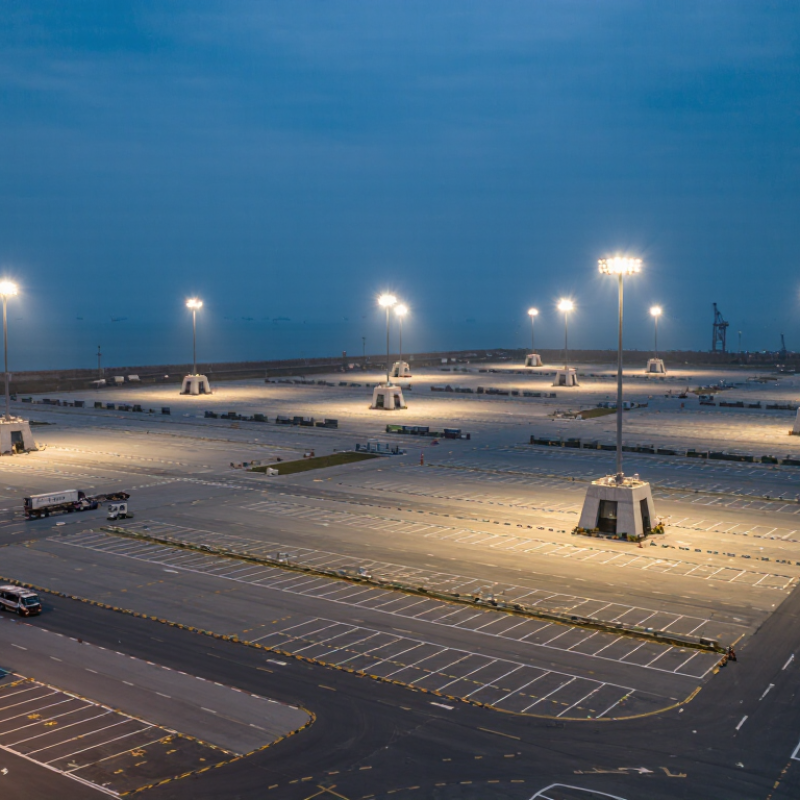
Ports, airports, and logistics yards frequently depend on this lighting arrangement. Containers, loading zones, and service roads need consistent illumination after sunset. At a busy freight terminal, shadows between stacked containers can hide people, vehicles, or damaged materials. Carefully aimed fixtures help reduce those dark pockets. However, lighting calculations must consider aircraft operations, nearby homes, and reflective metal surfaces.

Large stadiums, industrial compounds, and municipal parking areas are other practical locations. High mast systems can cover open spaces with fewer foundations and less underground cabling. Maintenance teams may also prefer lowering systems for safer lamp access. That choice depends on pole height, wind exposure, soil conditions, and lifting equipment. Small errors matter.

A site survey should examine glare, spill light, drainage, and future expansion. High mast lighting is not automatically the best answer for every large area. In some locations, lower poles provide better pedestrian comfort and more precise control. The right decision comes from measured requirements, local safety rules, and actual night-time conditions. Planning on paper alone can miss important details.

Factors to Consider When Choosing High Mast Lighting

Why Choose High Mast Lighting for Large Outdoor Areas?

Choosing high mast lighting requires more than selecting the brightest fixture. Mounting height, beam distribution, glare, wind load, and maintenance access must work together. A 30-meter pole may cover a wide yard, but poor optics can create dark lanes beneath it. I have seen operators increase wattage when the real problem was incorrect aiming. That mistake wastes energy.

Energy performance deserves careful review. The IEA and UNEP reported that lighting used about 15% of global electricity in 2020. Efficient LED systems can reduce consumption, but published efficacy is not the whole story. Ask for maintained lumens, not initial lumens. Check lumen depreciation, driver life, operating temperature, and control compatibility. The U.S. Department of Energy’s solid-state lighting research reports identify 200 lumens per watt as an important development target for future systems. Real installations may deliver less.

Glare control is equally important. CIE 150:2017 provides guidance for limiting obtrusive light near roads, homes, and sensitive areas. Review the photometric file before purchase. Simulate spill light at property boundaries. Also verify pole foundations and wind calculations with a qualified engineer. High mast luminaires are exposed to severe weather.

Maintenance is often overlooked. Lowering systems can reduce service risk, yet they add mechanical complexity. Nothing is maintenance-free. A practical design leaves room for inspection, cleaning, and future LED upgrades.

Article Source:

Back To Top